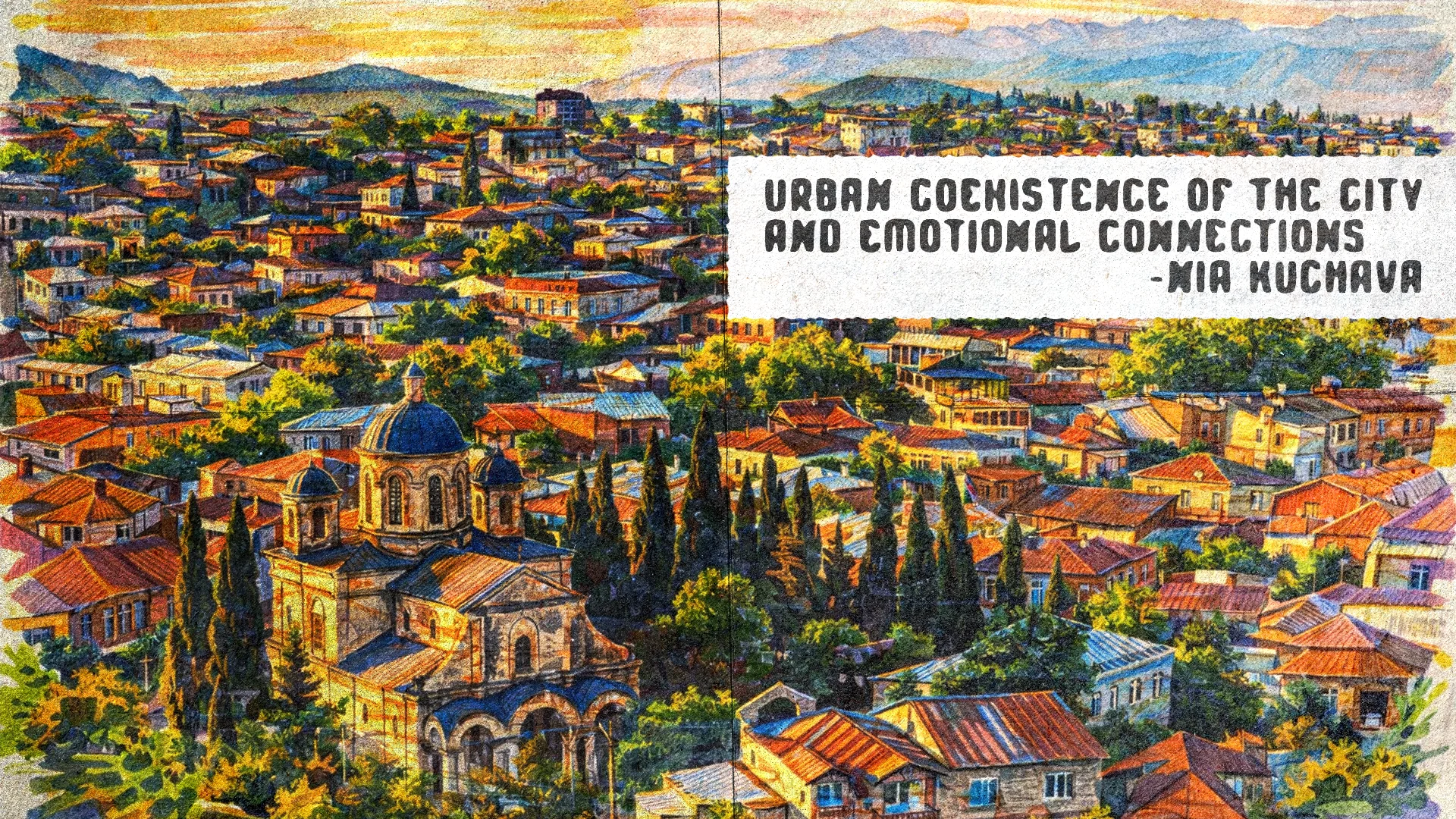
Author: Nia Kuchava
The idea of the city as a subjective experience is highly relevant to contemporary urban anthropology. According to recent tendencies, the city is no longer understood only through its formal and technical characteristics, but also through the systems of meanings and the material affects that individuals present within it experience or attribute to it. Accordingly, the popular view that people are connected to urban space through feelings of trust, familiarity, and comfort – in this case, specifically in the context of Kutaisi – may be shaped by different causes, including the phenomenon of cultural familiarity and the infrastructural particularities that evoke the affects mentioned above.
The cultural connection to urban space also includes informal practices. This is the aggregate of a group’s implicit ideas about its own cultural identity and belonging, the existence of which does not rest on formal legitimation or declared knowledge.[1]
Over the last several decades, a new line of thought has emerged in social and cultural anthropology that regards such informal practice as one of the unconditional causes of creating a sense of solidarity in society. Accordingly, an urban space such as the one Kutaisi offers should not be viewed only through bureaucratic relations and permissions; above all, this space is grounded in relationships and forms of relating between individuals. Therefore, for any type of group, informal practices – those that define personal relationships and, most importantly, the distribution of power within the dynamics of those relationships, the feeling of closeness, and the content of emotional exchanges – are one of the key determining factors. In urban space, people may form attachments to their homes, neighborhoods, districts, and to the spaces they themselves choose or arrange, and in relation to which comfort can be attributed to the embodiment of personal subjectivity. Common spaces in an urban context, by contrast, are stripped of individual arrangement, yet a sense of trust in and familiarity with them may still emerge at the individual level precisely because of the informal practices shared by the people present in that space. This very feeling of cultural familiarity may be expressed through self-irony, jokes about shared shame, metaphors, and nostalgia. This also explains why, in urban contexts, people often emphasize features toward which moral commentary and attitudes may not be unequivocally positive, yet through them they reinforce a sense of familiarity – one that arises, for example, through overcoming the affect of shame by marking a shared collapse.
A sense of cultural familiarity and belonging may also be expressed in material forms. According to the idea of the materiality of affect, urban space is not merely a collection of infrastructure and material objects, but an embodied phenomenon that is constantly transformed by the individual’s subjective relations and by social life.[2]
Such relations may also be decisive for the subjective perception of the city. Infrastructural stress is likewise important – stress that may trouble people because of the city’s constant transformation, unfinished works, and the feeling of instability. Accordingly, it is important to consider urban infrastructure not only in terms of its immediate function, but also in terms of the emotional investments and meanings that people attach to, for example, bridges and roads.[3] It is through these meanings that even the political dimensions that arise in urban contexts in relation to architecture and infrastructure are shaped, sometimes taking the form of feelings of isolation, abandonment, or political critique. This tendency is especially relevant in the context of post-Soviet space, where, in relations to architecture and urban arrangement, we can observe the destruction of old spaces and attempts to assign them new meanings, thereby linking those spaces to a new political reality.[4] Kutaisi, too, contains many buildings, including ones connected to the socialist past, that remind us of a past we criticize. There are also abandoned buildings that could have become symbols of a democratic future and an entirely new political vision, but which, in people’s memory, may instead absorb the meaning of trauma or of bidding farewell – through their abandonment – to that very potential, thus shaping the subjective perception of these spaces. Consequently, people are constantly orienting themselves within an atmosphere in which material objects are continually stripped of or granted old and new meanings, and this determines the subjective attitudes that exist in relation to the city and that are translated into popular, shared ideas in accordance with the affects that have been experienced. The discussion presented above concerns precisely those informal and material practices that create individual experiences of and feelings toward the city.
Bibliography
Herzfeld, Michael. Cultural Intimacy: Social Poetics and the Real Life of States, Societies, and Institutions. Routledge Classic Texts in Anthropology. New York: Routledge, 2016.
Knox, Hannah. “Affective Infrastructures and the Political Imagination.” Public Culture 29, no. 2 (82) (2017): 363-384. https://doi.org/10.1215/08992363-3749105.
Low, Setha M. “Embodied Space(s): Anthropological Theories of Body, Space, and Culture.” Space and Culture 6, no. 1 (2003): 9-18. https://doi.org/10.1177/1206331202238959.
Khalvashi, Tamta. “The Postsocialist City – In Search of Decolonization.” Social Justice Center. April 4, 2019. https://socialjustice.org.ge/ka/products/postsotsialisturi-kalaki-dekolonizatsiis-dziebashi.
-
Michael Herzfeld, Cultural Intimacy: Social Poetics and the Real Life of States, Societies, and Institutions (New York: Routledge, 2016), 14-20. ↑
-
Setha M. Low, “Embodied Space(s): Anthropological Theories of Body, Space, and Culture,” Space and Culture 6, no. 1 (2003): 9-18. DOI: 10.1177/1206331202238959 ↑
-
Hannah Knox, “Affective Infrastructures and the Political Imagination,” Public Culture 29, no. 2 (82) (2017): 363-384. DOI:10.1215/08992363-3749105 ↑
-
Tamta Khalvashi, “The Postsocialist City – In Search of Decolonization,” Social Justice Center, accessed on December 10th, 2025, https://socialjustice.org.ge/ka/products/postsotsialisturi-kalaki-dekolonizatsiis-dziebashi. ↑