Author: Lia Kharaidze
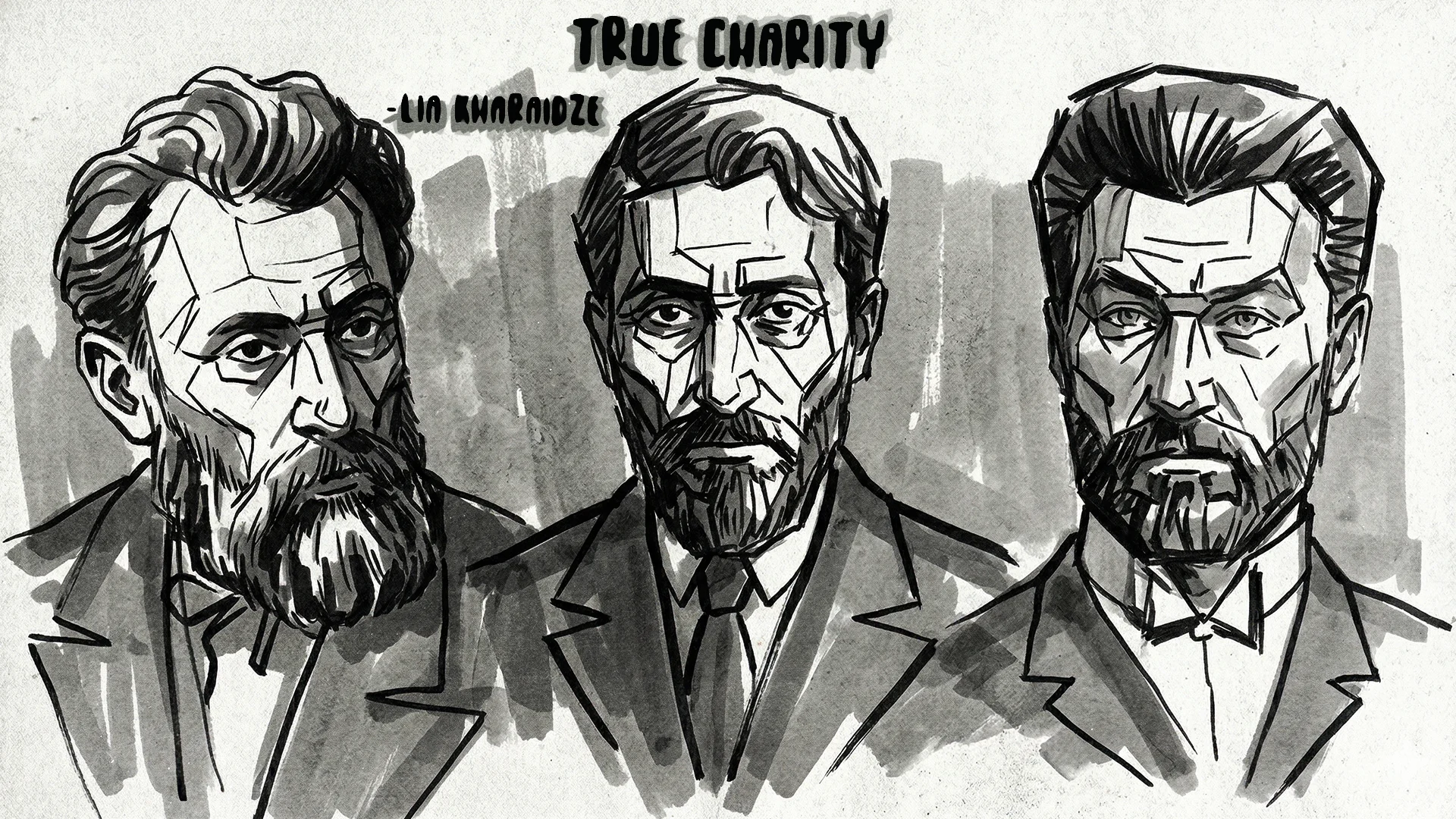
Lately, when people begin speaking about the history of manganese extraction in Chiatura, they mark the merits of Akaki Tsereteli and then move directly to Harriman’s activity in Chiatura. They note the terrible condition the American magnate found in the town and how much he managed to do in just a couple of years. No one denies Harriman’s role and contribution, but it is deeply regrettable to skip over several decades as though they had never existed, as though these people—whose work cost them their lives and the sacrifice of their families—had never even been born. Yet they managed to accomplish a great deal within a rather short and difficult period. It is precisely the activity of these great patriots that we intend to recall, so that we may at least pay some small tribute to their memory and remind contemporaries what true philanthropy is, and how vitally important the creation of an industrial society was for the newly established state.
At the beginning of the twentieth century, manganese was produced mainly by three countries: India, Brazil, and Georgia. Its principal consumers were the United States, Germany, England, France, Belgium, Austria-Hungary, and Russia. Georgia was the leader in manganese extraction, because the quality of our ore greatly surpassed that of other countries, which is why it retained unquestioned leadership on the international market, with only rare exceptions. As soon as production began, this small settlement was flooded with people for all kinds of reasons. The situation was further complicated by the fact that, owing to Chiatura’s geographical location, ore extraction there was easier than in other countries. During this period, exploitation of the Chiatura deposit had a predatory character. “In 1898 the French professor Evrard visited the Chiatura manganese deposit and declared: I have toured manganese deposits all over the world, but I have never seen such a rich deposit anywhere, nor have I ever seen such predatory methods of ore extraction” (“The City of Black Gold”). Anyone who was not too lazy and could get hold of even a little money extracted “manganese” however they pleased. Mining engineer G. Dekanozishvili wrote: “Everyone who possesses even one pickaxe and two shovels starts working and mercilessly destroys the wealth, because there is no one to supervise or instruct them.”
A part of society clearly saw both the harm and the benefit that accompanied exploitation of the deposit. The first attempt to bring manganese extraction within a lawful framework was the “Founding Congress of Industrialists of Shorapani Uyezd,” held in Kutaisi in 1896. Giorgi Zdanovich was elected chairman of the congress. A council of industrialists was established, and it played a major role both in regulating manganese exports and in developing Chiatura’s cultural life. It was already from this period that care for the town’s improvement began. Through the efforts of the council of industrialists, by 1914 Chiatura already had a six-grade civic school, a Sunday school, the Chiatura Higher School for Boys, a Higher Primary School for Girls, and a one-grade Greek school. The first teaching staff was selected with great care: Ivane Gomelauri, Simon Japaridze, Aleksandre Matiashvili, and Giorgi Anteladze.
Chiatura’s six-grade school was so progressive for its time that Iakob Gogebashvili wrote: “Among its peers, it is the best school.” Equally important was the opening of reading rooms – “These reading rooms were the first cultural and educational institutions.”
Ultimately, the lawlessness came to an end during the period of Georgia’s independence, when the joint-stock company “Chemo” was created. It took monopoly control into its own hands, and only it could bring manganese to market, thereby directing the export of the black stone in the interests of the state. Isidore Varazashvili is regarded as the company’s first chairman, although at different times “Chemo” was headed by G. Zdanovich, N. Nikoladze, and K. Abashidze. This company did not exist for long (1919-1925). Despite its brief lifespan, the company managed to accomplish many enduring and important deeds.
Let us begin with the fact that the company assisted underprivileged young people who wished to obtain an education. A substantial sum was allocated for scholarships intended both for pupils in primary and secondary schools and for students in higher education. Scholarships were awarded to students of higher educational institutions in Russia, Austria, Germany, Switzerland, France, and Turkey. If we take into account that these scholarships were later received by such well-known figures as Konstantine Gamsakhurdia, Sergo Kldiashvili, Davit Kakabadze, and Ioseb Qipshidze, we will understand how important the scholarship program of the industrialists’ society was. Before the declaration of independence, their activity had many enemies. In Iveria, in “Manganese,” the industrialist P. Tsulukidze wrote: “They even condemn the industrialists for spending money on schools, the theater, and libraries.”
Among the acts of philanthropy carried out by the council of industrialists, in addition to helping schools and the Society for the Spreading of Literacy among Georgians, it is worth noting their assistance to the Georgian population of Iran and their efforts to preserve the Georgian school there.
“In connection with the death of Ilia Chavchavadze, on September 5, 1907, an emergency session of the council of industrialists was held in Kutaisi, which discussed only one issue: ‘Commemorating the memory of the poet I. Chavchavadze.’ The council resolved: ‘A proposal shall be made to the regular congress of manganese industrialists that 10,000 rubles be allocated for scholarships’” (newspaper Iveria). The council of industrialists contributed 500 rubles for the erection of Ilia Chavchavadze’s monument. A representative of the council took part both in discussing the matter of the monument’s construction and in its unveiling.
Through the efforts of the joint-stock company “Chemo,” Akaki Tsereteli’s monument on Mtatsminda was erected. At their initiative, a library was purchased for the newly opened university. Even today, in Isidore Varazashvili’s family, a letter written by Ivane Javakhishvili is carefully preserved, in which he asks Isidore Varazashvili—who had gone to Europe on manganese business—to obtain laboratory equipment for the university. “Rustaveli” societies were established in Germany, specifically in Hamburg and Munich. Besides providing every kind of assistance to students abroad, these societies were engaged in other beneficial activities as well. Incidentally, the work of the “Rustaveli” societies has still not been studied, though it probably preserves many more interesting stories.
In 1926, Isidore Varazashvili, together with Niko Nikoladze, founded the honorary publishing society “Georgian Book” in Tbilisi, where the complete collected works of Ilia Chavchavadze were published, as well as poetry collections by Nikoloz Baratashvili and Grigol Orbeliani, and translations of foreign classics by Konstantine Gamsakhurdia.
Unfortunately, they were not given time to carry out their great plans. It was precisely Niko Nikoladze and Isidore Varazashvili who were behind the plan for the industrial ring “Chiatura – Zestaponi – Poti.”
This is only a small list of the public activities that the council of industrialists carried out from the day of its foundation. Much remains to be studied; much has probably been destroyed, or at best is difficult to trace, because almost none of the members of the industrialists’ union escaped repression. Their human tragedies are a separate subject and unquestionably demand attention and tribute. The philanthropy carried out by this society has truly withstood the test of time.