Author: Mariam Mebuke
In discussions of Soviet architecture in the Imereti region, the sanatoriums of Tskaltubo may be the first thing that comes to mind. My aim here is to uncover and discuss the “hidden” – and at times overlooked – architectural examples found in Kutaisi.
Before turning to specific buildings, it is worth briefly reviewing Soviet modernist architecture in general, a field that has become increasingly interesting to art historians over time. This growing interest can be explained by several factors: the rediscovery of a rich modernist architectural heritage that had been cut off from Western history as a result of the Cold War. Interest has also been shaped by the fact that, after the loss of many works from the Soviet period, post-Soviet societies began to recognize the importance of these buildings not only as architectural and historical monuments, but also as significant socio-cultural components of their collective identity.[1] Soviet architectural modernism was one of the three main architectural trends in the Soviet Union. Until the twenty-first century, Soviet modernism did not exist as a distinct category in architecture. The term generally refers to examples created between 1955 and 1991. The transition to modernism began with the decree of November 4, 1955, issued by the Central Committee and the Council of Ministers of the USSR, “On the Elimination of Excesses in Design and Construction.”
Architectural modernism entered the USSR from the West and was then transformed into a Soviet form. During the so-called “Khrushchev Thaw,” specialized professional journals became openly accessible to Soviet architects, and exchanges of experience began with architects from Poland, Cuba, and Hungary. In fact, the international character of modernism was one of its main distinguishing features.
More specifically, the origins of Soviet modernism should be sought directly in the works of Le Corbusier, who by the 1950s had reworked the foundations of Soviet constructivism into a new and personal architectural style.
As for the term “Soviet architectural modernism,” it was introduced in the early 2010s. Before that, it essentially did not exist. To this day, there are no exact criteria defining Soviet architectural modernism, apart from its relatively clear chronological period.
An important role in identifying this style was played by the French photographer Frederic Chaubin, who traveled throughout the former Soviet Union in the early 2000s and photographed numerous buildings that at the time were regarded almost exclusively as examples of Brutalism.
This brings in another architectural style as well: “Brutalism.” It is difficult to speak clearly about the boundaries between Brutalism and modernism, because, in the view of many scholars, Brutalism became the foundation of Soviet modernism. Like Brutalism, Soviet modernism was characterized by the functionality of massive forms and structures, as well as by the urban appearance of buildings. Compositional decisions were presumably intended to reflect the scale of advanced ideas and the anti-bourgeois principles of Soviet life. As in Brutalism, reinforced concrete was the principal building material of Soviet modernism, and the approach to architectural commissions was complex. It should, however, be noted that it would be incorrect to equate this architectural style entirely with Brutalism, because there were important differences between them. One distinguishing feature of Soviet modernism, for example, was the use of facing materials such as marble, sandstone, shell stone, ceramics, and others.
Another characteristic feature of this style – especially during its developmental phase – was decorativeness, for example mosaic panels, bas-reliefs, and other modernist decorative elements of monumental art. Extensive glazing of building surfaces was also typical, which partly recalls constructivism.
The Soviet architecture of Kutaisi is a good example of how this style was expressed. In the sphere of monumental art, one should mention one of the most striking manifestations of Soviet modernism in Kutaisi: mosaic panels and bas-reliefs.
Among the Soviet-era mosaics in Kutaisi, the residential block on Chavchavadze Avenue stands out. This mosaic reflects Kutaisi’s significance as a center of production through its depictions of factory workers and machinery. The admittedly partial author of this article notes that the content of architectural examples of this type should not determine their value, because, as has already been discussed, Soviet art reflected the propaganda that the regime needed in order to reshape people’s thinking in a total way. Accordingly, my purpose here is to speak about the value of the technique by which these architectural examples stand out, rather than the value of their content. There are many mosaics on Chavchavadze Avenue. Among them, one that does not depict Soviet propaganda and can be viewed as a work of abstract art is the mosaic on another residential block, where it is difficult to make out any specific plot. Mosaics can also be found on the wall of the former garment factory. On the main panel of the former electromechanical factory one also encounters depictions of a man and a woman presented in workers’ uniforms. Some of these mosaics have been damaged over time, making it difficult to identify particular figures more precisely. At the western end of the factory there are remnants of a sports-related mosaic, while east of the main entrance there is another wall displaying an example of abstract mosaic art. The abandoned tea pavilion preserves yet another such work, created with comparatively large tiles. The building is notable for its abundance of different characters, including doves and young pioneers – another manifestation of Soviet propagandistic art, the idea that “being a pioneer is good and necessary.” For those interested in Soviet-era mosaics not only in Kutaisi but throughout Georgia, there is additional literature available. One such source is Nini Palavandishvili’s Soviet-Era Mosaic in Georgia. There is also an online map titled Late Soviet Modernism and Soviet-Era Mosaics in Georgia.
Another interesting example is a Soviet-era panel located in the city center. It even has a title: Colchis. It belongs to the artist Bernard (Franz) Nebieridze. It has stood in this location since 1995 and remains untouched to this day.
As for buildings, one of the most notable is the structure of the joint-stock company “Electromekanikosi.” At the entrance to this building, designed in the style of Stalinist architecture, there is also a memorial plaque describing its function as a cultural center, although it is clear that it is no longer used for that purpose. The cultural center dates to the mid-twentieth century.
This overview must also mention the monument to Galaktion Tabidze. The monument was created in 1990, precisely when the Soviet Union was on the verge of collapse, and it is the work of the sculptor Giorgi Shkhvatsabaia. And, if you have not yet tried the application Phantoms: An Extraordinary Exhibition, where one of the zones is the area surrounding Galaktion’s monument, it is worth experiencing.
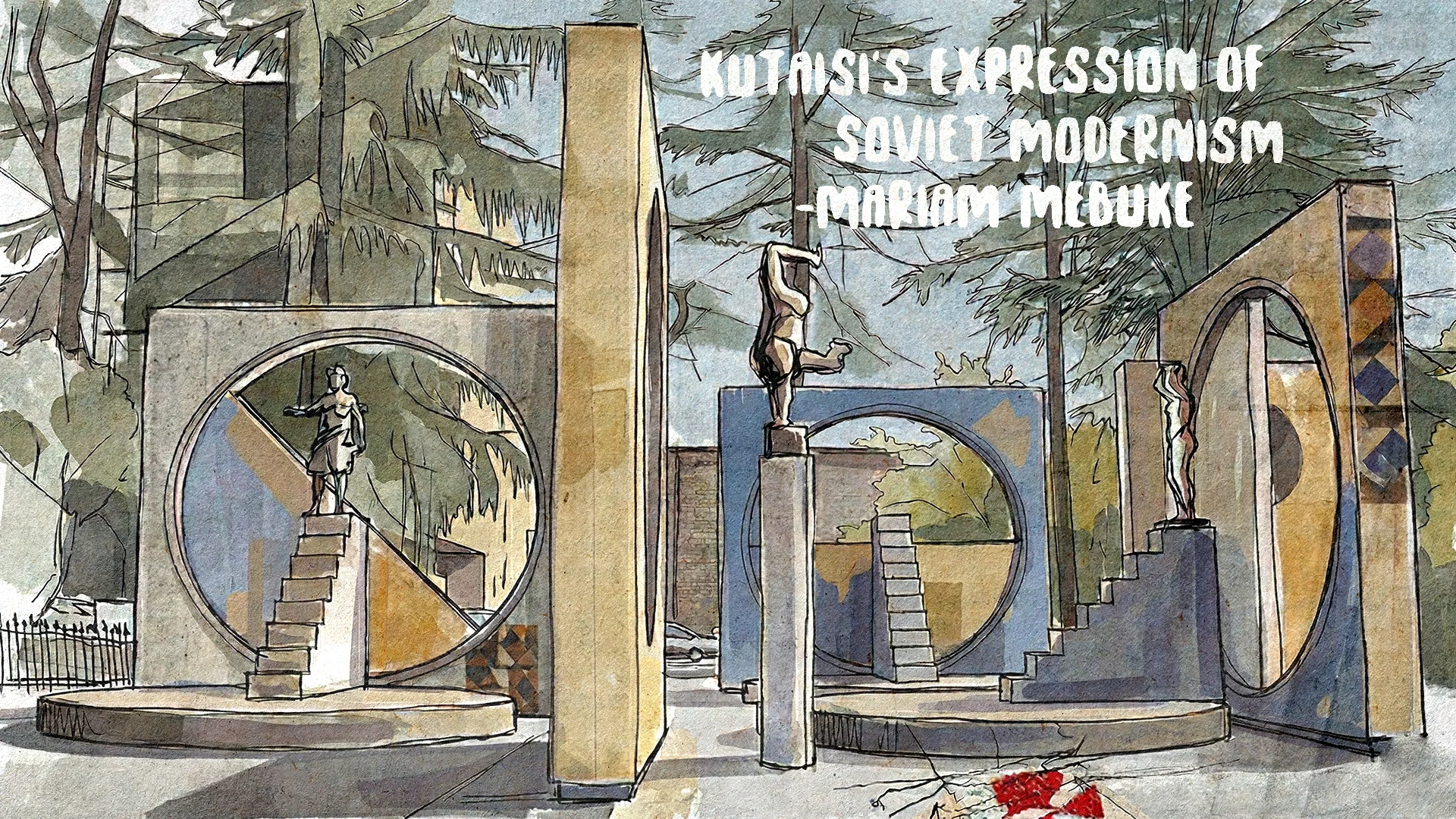
The “Memorial of Labor Glory,” created in 1975 by Shota Bostanashvili and Vakhtang Davitaia, should also be noted.
“The memorial produces a series of situations: every two years, presentations of sculptural works by different sculptors should take place here. From this place they will move to the art gallery. The Kutaisi memorial is the architectural heart of Kutaisi’s cultural life, an unchanging stage with changing participants (sculptures, citizens). This simultaneity of the permanent and the changing is the memorial’s main cultural meaning.” – Davit Bostanashvili.
To a certain extent, this article has turned into a guide for those interested in examples of the architecture and art of Soviet Kutaisi, while for those who already know about them, it serves as a kind of reminder.
The collective project of constructing Soviet modernity came to an end in the early 1990s with the dissolution of the USSR. Most of the utopian projects of that modernity remained as fragments or collapsed altogether.