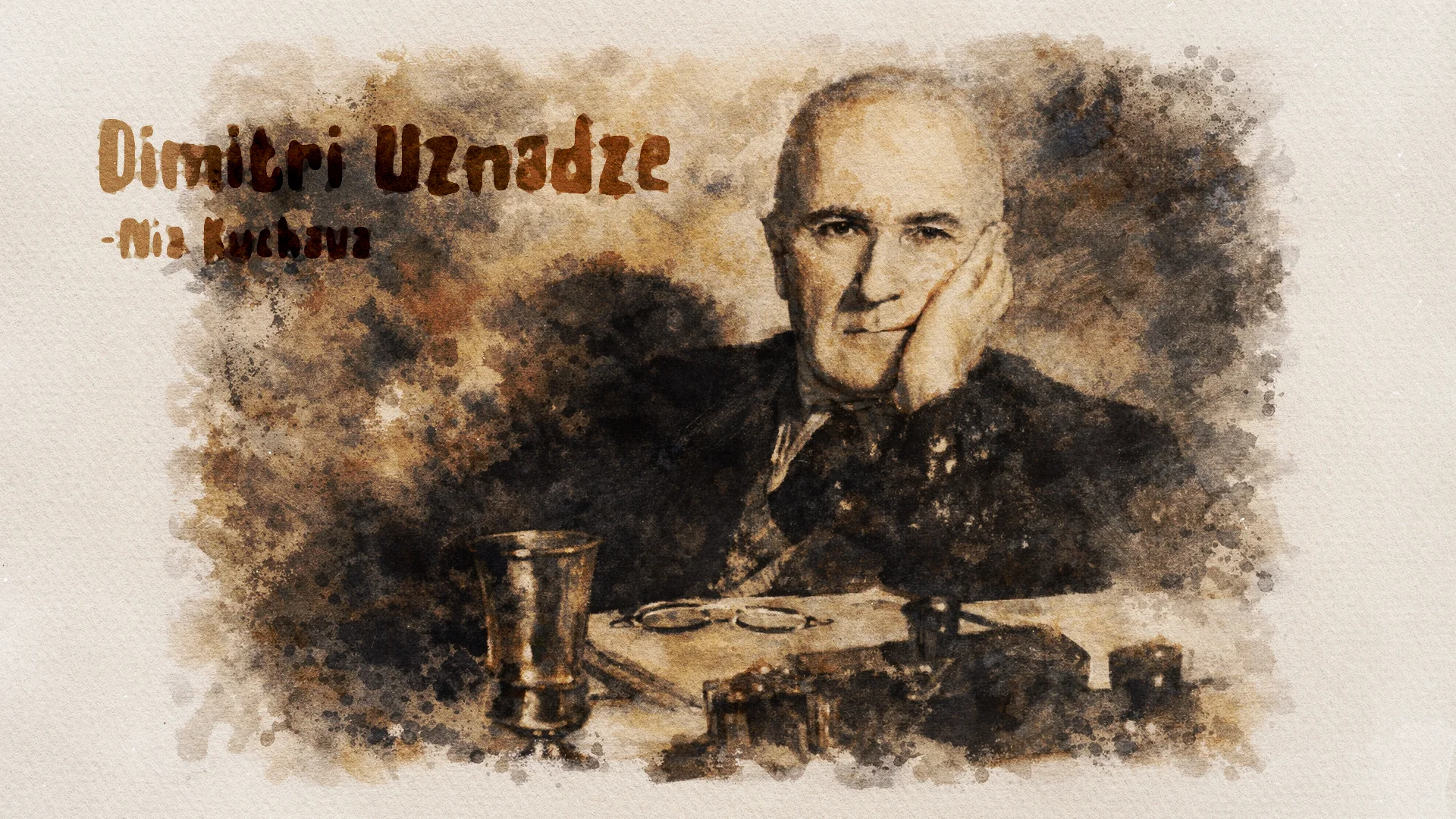
The Scientific and Pedagogical Legacy of Dimitri Uznadze
Author: Nia Kuchava
Dimitri Uznadze’s academic work has been one of the key factors in the development of the Georgian school of psychology. His pedagogical approach and research methods are especially important both for the development of Georgian academic discourse and for the international scientific community. The theory of “set” (or “attitude”) formulated by Uznadze, as well as the methods with which he studied the unconscious, were largely based on his European education and his relationship with Wilhelm Wundt, the founder of experimental psychology. However, alongside continental psychology and such important thinkers, there is a less emphasized, though no less significant, direction in the work of Dimitri Uznadze. His pedagogical and research activities were also influenced by his work in Western Georgia, and especially interesting were the developments taking place in the Light society. This article will conceptualize both Dimitri Uznadze’s theory of “set” within academic discourse and will also discuss his scientific method and his main connections with Western Georgia.
Dimitri Uznadze is one of the founders of Tbilisi State University, and because of this, he constantly tried to systematize psychology and refine pedagogical approaches. In the introductory chapters of his books, he often mentions his desire to create a textbook that would systematize specific subtopics and directions of academic psychology, including adolescent psychology, in such a way that these books would provide solid knowledge for higher-education courses. It is precisely because of this goal that Uznadze’s works are marked by a wide range of issues and maximum comprehensiveness. Accordingly, his academic writings represent an attempt to synthesize theory with the challenges relevant to his educational activities and to respond to these difficulties. Considering that the Department of Psychology was created when there was a lack of qualified specialists and literature, the thematic diversity of Dimitri Uznadze’s works becomes even more practical and meaningful.
Dimitri Uznadze was born in the village of Sakara, in the Zestaponi district of what was then the Kutaisi province. His life soon became connected with Kutaisi, where he studied at a boys’ gymnasium, though he was quickly expelled because he was suspected of participating in revolutionary activities. His studies in Germany introduced him to the foundations of continental philosophy and psychology. After completing his studies in Europe, his main challenge was to place the experience he had gained in Wundt’s psychological laboratory into the Georgian context and, despite limited academic resources, to continue his research and share his knowledge. At this time, his work in Kutaisi – where he taught and wrote his first textbooks- became a turning point. He founded the Georgian School for Women within the Light Society. Its pedagogical approach and educational activities are especially important because, in the first half of the 20th century, women were mostly excluded from scientific processes and academic dialogue. Pedagogical and research approaches were not directed toward women; there was little interest in their psychological characteristics or the possible gender differences that might exist. This detail is crucial from an educational point of view, because when we discuss education, we must take into account its social and cultural dimensions, which are largely determined by gender markers.
Despite the diversity of his research topics, according to the International Academy, Dimitri Uznadze’s most important contribution to psychological discourse is his theory of “set.” In his textbook General Psychology, Uznadze notes that both main views on purposeful action ignore essential knowledge about this phenomenon. One is the mechanistic view, which understands a living organism mechanically, meaning that its actions are determined by mechanical patterns that are reduced to the simplest regularities. This tradition is still quite influential in psychology, although, as Uznadze states, such an approach leaves much of the experience of a living organism—and the dynamics of purposeful action outside the scope of physical scientific explanation. The second view stresses the difference between the organic and the inorganic and creates an irreconcilable divide between immaterial essence and material manifestations. Therefore, such a dualistic approach is also rigid and cannot fully explain experience as a phenomenon. Dimitri Uznadze tries to address this dilemma by offering an alternative with his theory of set and by seeking the cause of purposeful action not in the material itself, but in how this material is organized and arranged. For Uznadze, the problem is that if everything has a material cause (based on the principle of causality), then all actions of living beings are determined; yet, at the same time, actions have a subject, an object, and a specific goal toward which the subject strives. Uznadze explains that a set is a holistic category that does not have only one specific direction, and he argues that constant interactions should be understood as a unity rather than as separate elements, as was the case in the two extreme viewpoints mentioned above. For him, set is an unconscious readiness – a state created when two factors coincide: internal motivation and desire (for example, hunger) and the recognition of an external object or situation that can satisfy this internal need. Therefore, a set is a kind of mediator that precedes consciousness; any cognitive process begins only after the set is formed – only then does a person start orienting himself in the surrounding environment.
These conclusions and findings were aimed at solving even larger philosophical problems. His scientific method, whether in his discussion of the illusion of heaviness or in general experimental psychology, was directed at connecting the phenomena behind unconscious attitudes, behaviors, and actions with empiricism. This was extremely difficult because of internal contradictions. His approach treated the unconscious as an ontological category – as something even more accessible and visible. Thus, his methods were innovative because he attempted to resolve seemingly irreconcilable categories and dilemmas. The international recognition of his ideas and their importance for general psychological discourse are also significant in the local context, because his innovative approaches shaped by leading figures and trends in European philosophy and psychology were inseparable from his work in the Georgian academic space, which was under strong pressure from the Soviet regime and where, alongside shared knowledge, new trends and new knowledge in education were also being systematized.