Author: Nia Kuchava
The study of cemeteries and the system of meanings associated with them in the urban context is a highly topical subject in modern social and cultural anthropology.
In addition to their practical and ritual functions, cemeteries have acquired important symbolic meanings within urban space, which are interpreted differently by various authors and theoretical approaches. In this brief analysis, I will discuss several perspectives on the symbolic load and social understanding of cemeteries as elements of urban space and will connect these considerations to the local context of cemeteries in Kutaisi.
First of all, the functionalist understanding of the cemetery as an urban space defines its meaning and purpose as a form of social consolidation of personal and individual identity. In particular, through the grave, a person who, in the immanent world and within a linear perception of time, has been deprived of movement in time and space, continues to exist within this model through the grave itself. The grave preserves symbolism associated with the individual in material form within the dimensions of this world. Accordingly, from an external perspective, a person bids farewell to their total subjectivity at the moment of death, while the grave becomes a public confirmation of their past existence, as it is perceived solely from the viewpoint of the outside world – by others who are separated from the individual. This perception is based only on the principle of influencing the memory of others. Therefore, the function of the cemetery can be defined as a liminal boundary between the secular and the transcendent dimensions.
In addition to these classical interpretations, anthropologists, by observing the forms of cemetery organization, comment on the characteristics of everyday life, since the care, construction, and planning of cemeteries reflect not only sacred but also secular cultural trajectories. It is particularly relevant to understand cemeteries as public spaces and to discuss their planning in relation to ecological and social functions. However, it should be noted that in the Georgian context, cemeteries are less subject to systematic planning and are rarely discussed in terms of policies aimed at specific, targeted transformations. As a result, the role of Georgian cemeteries in urban space and culture is shaped not by a unified project, but rather by individual attitudes and practices.
Another relationship that is important for the cultural and urban understanding of cemeteries arises from the idea of the materiality of affect. Feelings of sadness or positive emotions toward the deceased take material form in graves and become a physical embodiment of these emotions. Taking into account the functional understanding mentioned above, cemeteries acquire a dual meaning in everyday culture, particularly in Western contexts. On the one hand, they preserve a social connection with the dead and symbolize the individual’s removal from linear time, thus evoking sadness expressed through mourning rituals and cemetery visits. On the other hand, the grave represents the social bond that a person maintains with the world, which can also produce a more positive interpretation. For this reason, people visit cemeteries for emotional relief, peace, or, based on religious expectations, for solemn ritual solidarity. This dual relationship defines the cemetery as a specific type of urban space.
It is for this reason that one of the most widespread trends in cemetery maintenance in the Kutaisi context is their expansion. The more diverse and complex the cemetery infrastructure becomes, the more solidified the embodiment of the deceased’s subjectivity appears. As a result, graves often reflect the deceased’s urban identity, as families attempt to transform the individual’s social and cultural capital into material attributes of the grave.
This practice, together with the care of plants on graves, functions as a form of legitimacy and status for the deceased. Both plants and infrastructure are characterized by territoriality and spatial distribution, occupying a specific place within the city and thus presenting a broader and more stable embodiment of the deceased. The connection between graves and social or cultural capital in the urban context is further confirmed by the existence of pantheons, which represent another way of reinforcing the status of individuals with particularly significant social or cultural influence.
Religious practices are also closely connected to the cultural and social dimensions of how graves are understood, especially during the Easter period. At this time, visiting cemeteries has become a widespread practice, involving almost everyone, regardless of individual moral interpretations. The traces left in cemeteries during this period are perceived as confirmation of the preserved bond between the deceased and their families, as well as a justification for why the cemetery occupies a specific territory within the city. This is especially important given that land has economic value, and maintaining cemeteries is economically unprofitable. This “cost” is justified precisely by the visible traces of these social and emotional bonds.
Based on the above-mentioned system of meanings related to grave-care practices, the idea of abandoned graves evokes particularly strong social and cultural assumptions and emotions. The Sapichkhia Jewish Cemetery in Kutaisi is one of the most striking examples in terms of urban interpretation, as it clearly reflects the social and demographic determination of the cemetery and embodies an important part of the city’s historical diversity, namely the Jewish quarter. However, today the Jewish cemetery is abandoned, which indicates broader trends and characteristics of migration.
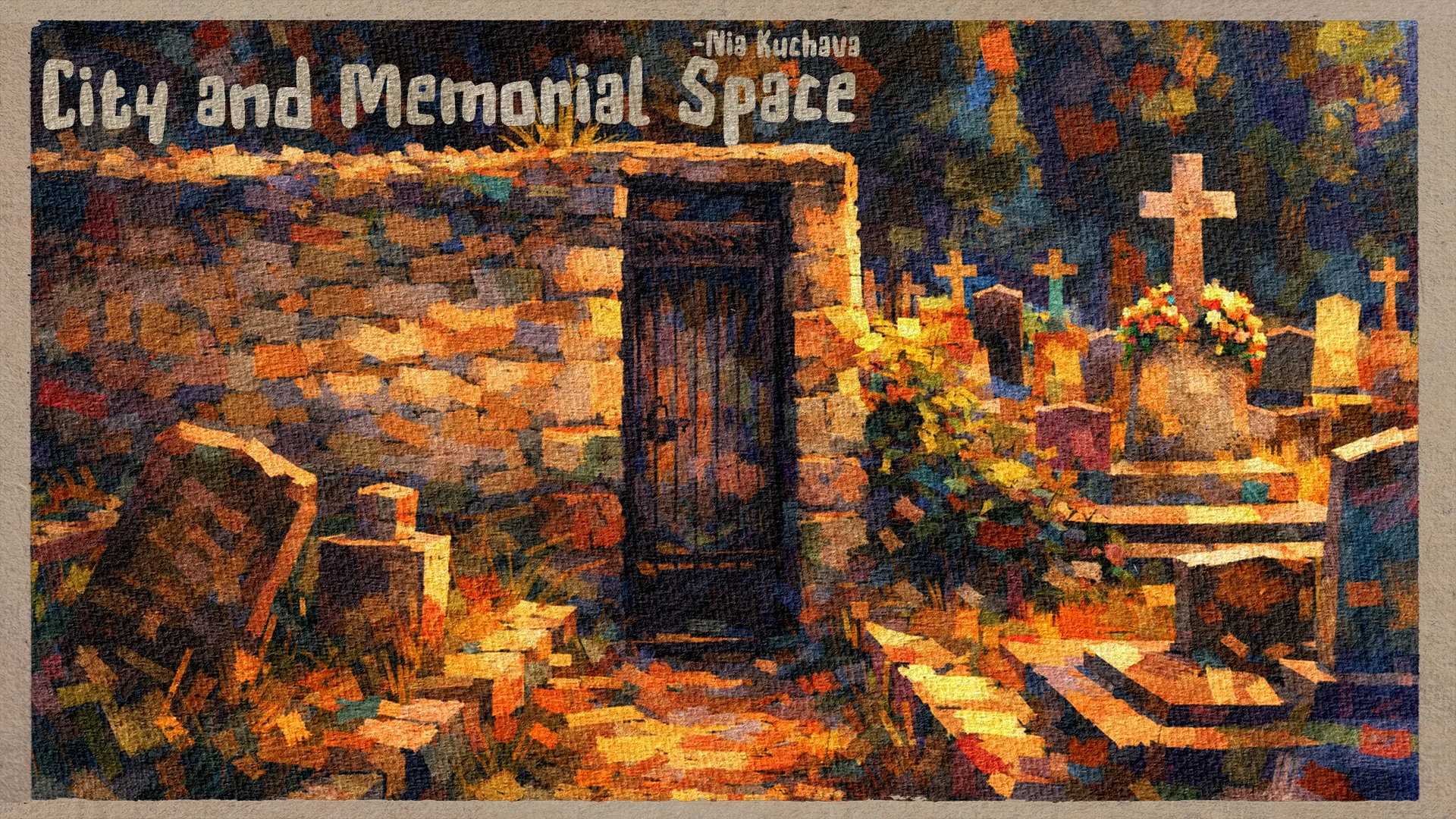
The Jewish cemetery is separated from the Christian cemetery by a wall, and the contrast between them is clearly visible. The severance of ties with the former urban status can explain the breakdown of care practices and the changes associated with them. This once again demonstrates that a cemetery is not only a place with a specific function for the deceased, but cannot be understood without considering the urban, socio-cultural, and historical contexts and the values assigned to it, discarded from systems of meaning.