Author: Mariam Mebuke
It is often said that the history of Kutaisi is rooted in the city’s rich antiquity and culture. Recently, I came across a work by the artist Gocha Chkhaidze called House on Tsereteli Street. That is why I decided to talk about the architectural character of Kutaisi in this article. Part of the city’s culture consists of its buildings, bridges, and overall urban style, which often escape our attention. This time, let us look at the history and significance of the famous bridges of Kutaisi.
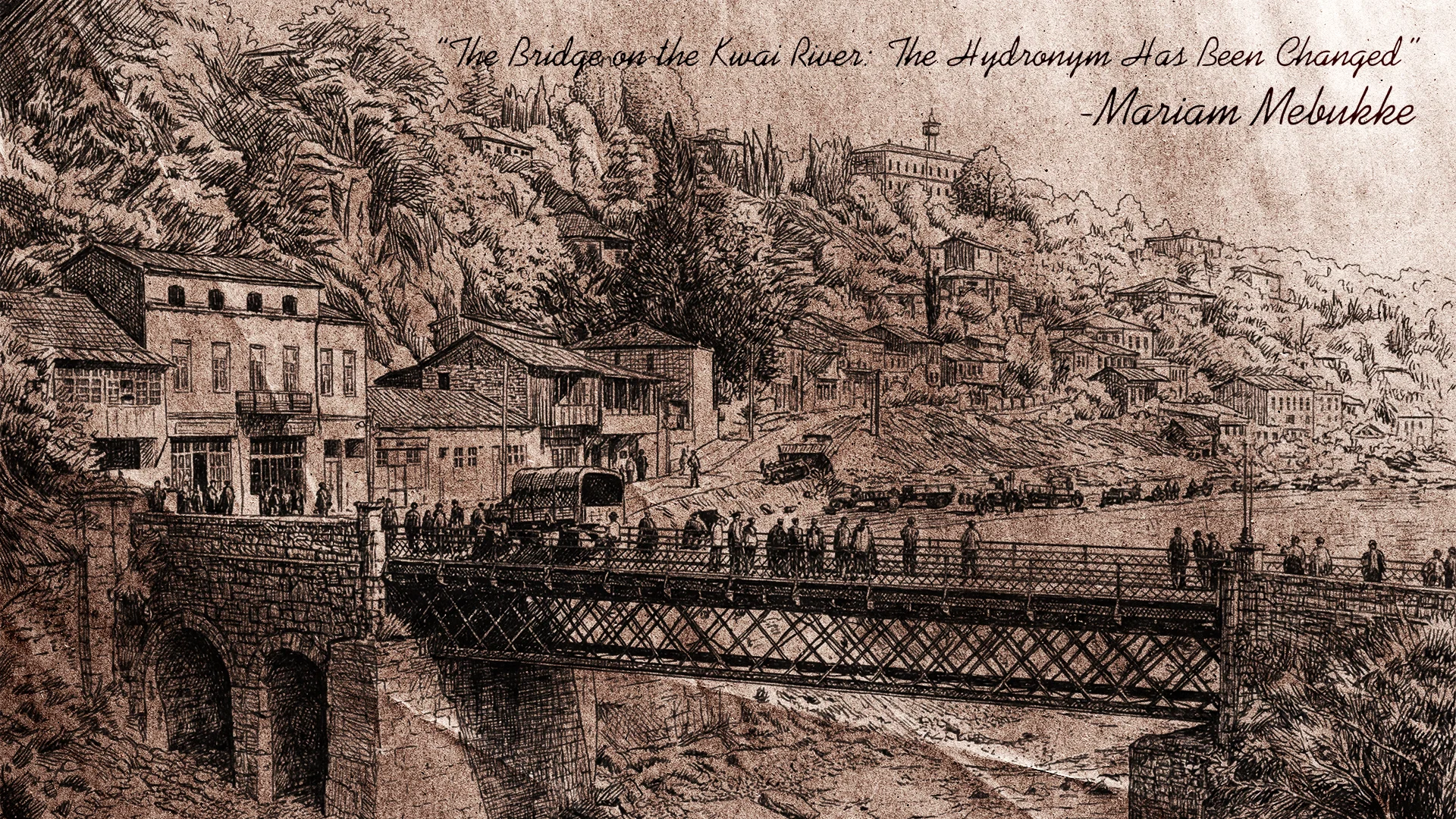
When I speak to friends visiting the “City of White Stones” for the first time and want to tell them about its architectural value, I usually begin with the Shota Rustaveli Bridge, the White Bridge, the Red Bridge, and the Chain Bridge, which are all located near the ancient district. It is logical that many bridges appeared in the city thanks to the Rioni River. Let us begin with the Chain Bridge, the oldest bridge in Kutaisi. It is worth mentioning that the remains of a 5th-century bridge were discovered here. The main supports of the current bridge date back to the 1870s, and at that time, it was known as the “Royal Bridge” or the “Stone Bridge”. During this period, a wooden bridge was built and was called the “Archieli Bridge”. It received this name because “Archieli Hill” still exists today, where traces of ancient settlements were found. According to one version, ancient Kutaisi was built on this very hill. Part of “Archieli Hill” was submerged under water, but a portion of it still remains. This hill is the area next to today’s Chain Bridge, which explains why the bridge once carried this name. Later, in the 1850s, chains were added, and the bridge received its current name.
In 1772, Johann Guldenstedt, a German scientist and traveler, arrived in the city. It is important to note that his extensive travel notes describe not only Kutaisi, but also Imereti and the whole of Georgia. He wrote that in the middle of the city, there was a wooden bridge twenty-five steps long, which was later referred to as the “arch bridge”.
“August 14. I spent the night again in Kutaisi. After the day before yesterday, the water of the Rioni River fell by 5 feet! We left Kutaisi in the afternoon, crossed the Rioni Bridge, and then passed a small church on top of a limestone mountain, which the king built when he camped here last winter, at the ruins of Kutaisi fortress! About 1 verst. After about one hour we crossed a river coming from the north, a river about which no one could tell me whether it flowed into the Rioni or the Tskhenistskali; another hour later we walked along the Khomuri plains to the head of the Tskhaltubo River, which emerges from a horizontal crack in the limestone rock and is 10 paces wide and 2 feet deep.”
The “Rioni Bridge” mentioned in Guldenstedt’s memoir is the Chain Bridge, because at the time of his visit to Kutaisi (1772), there was no other bridge. It should be noted that although this bridge was the only one, it became unusable in the 1850s, and therefore it became necessary to open a new bridge, the one we still know as the “Red Bridge”. It was opened in 1862, but the residents of the Gori district were unhappy with it, because they still had to travel long distances to get around, even if they used the new bridge.
According to sources, in the 1860s, on the night of Epiphany, when merchants from Gori were crossing the bridge with their wagons, one side of the chain broke. This did not happen because the bridge was poorly constructed. Apparently, unlike today’s winters in Kutaisi, the city then received heavy snow, and the snow-covered chain broke because it had not been cleaned in the previous days (the author explains this by the previous holidays and, therefore, a cultural-anthropological feature typical of Georgians). The city had to restore the bridge using its own resources, which were not available at the time. Restoration became possible only in 1884 – 1885. The bridge has appeared in its current form since the end of the 20th century, in 1995, when the present construction was built.
If we follow the history of the bridges chronologically, we should now talk about the Red Bridge, which, as mentioned, was opened in 1862. It is said to be the first iron bridge not only in Kutaisi but in all of Transcaucasia. There is also an assumption that the iron structure used for the bridge was made in the same factory where the Eiffel Tower was produced. What is certain is that the material for this bridge was ordered in France and manufactured there. When hearing the name “Red Bridge”, every resident of Kutaisi immediately remembers the famous magnolia tree that announces the arrival of spring in the city.
Do you like seagulls? Have you seen them on the banks of the Rioni River? You can probably guess which bridge we are talking about now. The supporting pillars of the Rustaveli Bridge are shaped like a seagull with its wings spread, though you should not associate it with Jonathan Livingston or anything similar. If you have not thought about it before, look at its structure from the nearby square, and everything will become clear. Construction of this bridge began in 1962 and, according to the plan, it was supposed to serve as a “road bridge”.
I will be subjective and say that I slightly mixed up the chronology at the end (you may have noticed), because I saved the “sweet treat” for last. I will finish my story about the bridges with the White Bridge. No one has visited Kutaisi even once and has not heard anything about this bridge, or at least, thanks to Rezo Gabriadze’s story or sketch, does not recognize it. Its history begins in 1850, when the decision to build the bridge was made, and two years later, it was opened. The author of the project was a military engineer named Witte. The location is the central part of Kutaisi, an ancient historic district crossing the Rioni River. Eight years after opening, the bridge, which stood on wooden arched piers, collapsed in 1860, and it was restored only in 1870. Its first reconstruction took place in 1860 – at that time, the railings were painted white, which gave the bridge its name. We should not forget the “Picasso Boy” sitting on the railing and Eldar Shengelaia. In 1871 – 72, the White Bridge was rebuilt according to the project of engineers Zezeman and Perep. During the restoration, the railings and metal parts were again painted white.
All the bridges mentioned continue to play an important role not only in the cultural appearance and history of the city, but also in a practical sense, through transportation. That is why, whenever I begin telling friends about the history of Kutaisi, I stand on one of the bridges, most often on the Rustaveli Bridge, because from one side you can see the Red Bridge, and from the other, the White Bridge. Unfortunately, we do not have much information about the bridges of Kutaisi – the history has been lost – but I hope that I have at least partly reached my goal.