Author: Lia Kharaidze
The history of the Argveti Saeristao begins with King Parnavaz. “…Was sent to Margvi as Eristavi and gave him a small mountain, which is Likhi, up to the sea above the Rioni. And this Parnavaz built two fortresses.” (Vakhushti, Description of the Kingdom of Georgia.) According to Leonti Mroveli, the Argveti Saeristao included the territory from the Likhi mountain to the Rioni and from the Racha mountains to the Fersati mountains.
The rise of the Baghvash-Orbeliani dynasty began after they took control of Kldekari together with the Argveti Saeristao. Kldekari, as a border domain, was extremely important strategically because it was truly the gateway leading from Byzantium into the heart of Georgia. Both allies and enemies understood this well. The Byzantine emperors made strong efforts to support the Baghvash family. This feudal family became known in Georgian historiography as rebellious eristavis, but besides this, they also carried out major construction projects. Many unique works of art are connected with their name – works that have survived to this day and still amaze us. The treasure is the main topic of this article, but we should also mention the place where this treasure was created.
One of the centers of the Argveti Saeristavo was the village of Katskhi. Here stood the church and crypt of these feudal lords; they also had fortresses, which were considered symbols of feudal power at the time. The palace has not survived, although even today peasants still find clay pipes while cultivating the land, which tells us that a well-functioning irrigation system existed during that period. The Katskhi fortress survives in ruins, and only the church was preserved in its original form. (It was rebuilt twice, but its original appearance is fully preserved. Traces of later restoration are clearly visible.) The “Katskhi Church of the Nativity of the Savior” is a unique architectural monument. “…Above it flows the river Katskhistskali… above this water stands the Church of the Savior, domed, of great beauty.” (V. Batonishvili.) The Swiss traveler Dubois de Montperre considered the Katskhi Church of the Savior to be a model of Georgian architecture, which is even more remarkable because almost no monuments of this type have survived to our time. “The most important representative of this type of Georgian architecture, characteristic of a certain stage of the architectural style” – this is how academician Vakhtang Beridze evaluates the Katskhi temple. “Katskhi was originally the domain of the powerful Baguashi family. The temple was built by Eristavi Rati.” (V. Beridze, Ancient Georgian Architecture, 1971.) I would also like to add that, according to the Chronicle of Kartli, the following princes are buried in the Katskhi Cathedral of the Nativity of the Savior: Rati, Liparit IV, Giorgi Abashidze (called Malakias), the chief of Argveti, Levan Abashidze… (V. Beridze, Ancient Georgian Architecture, 1971.) As we have already mentioned, Katskhi was an important political and cultural center in the early Middle Ages. During this time, as they say, “life was boiling here.”
The treasures of Katskhi are mentioned repeatedly in written sources. (For example, “Svimon Japaridze, the king of Imereti, gave the Katskhi fortress and treasury to Alexander V,” writes the Chronicle.) The Katskhi Cathedral was a place of active creative work; hundreds of books were copied here. The cathedral had a rich library. Unfortunately, the cathedral burned several times, and after the fall of the Baghvashi dynasty, ownership changed many times, which led to the destruction of its unique library. The “Katskhi Gulani” (a collection established in Georgian liturgical practice, which includes service books) has survived to our time and is now kept in the Kutaisi State Historical Museum. It gives us a clear idea of the strength of the Katskhi school of manuscript copying. “A faithfully compiled book” – this is how S. Orbeliani explains the Gulani. Gulani is an original Georgian phenomenon, and no other church tradition has it. It contains exclusively theological books. Only the richest churches had the luxury of creating a Gulani. Some Gulanis weighed 2–3 pounds. The “Katskhi Gulani” was likely created by masters working in the monastery. The manuscript uses ancient Georgian-style ornaments: vine branches, geometric figures, and plant motifs that decorate the entire text. The book contains miniatures based on biblical themes. The color palette is noteworthy: red, blue, green, and gold – the colors characteristic of Georgian church manuscripts. The text is written in Khutsuri-Nuskhuri. “This manuscript is an important part of Georgian Christian culture; its artistic decoration reflects the artistic traditions of medieval Georgian books.”
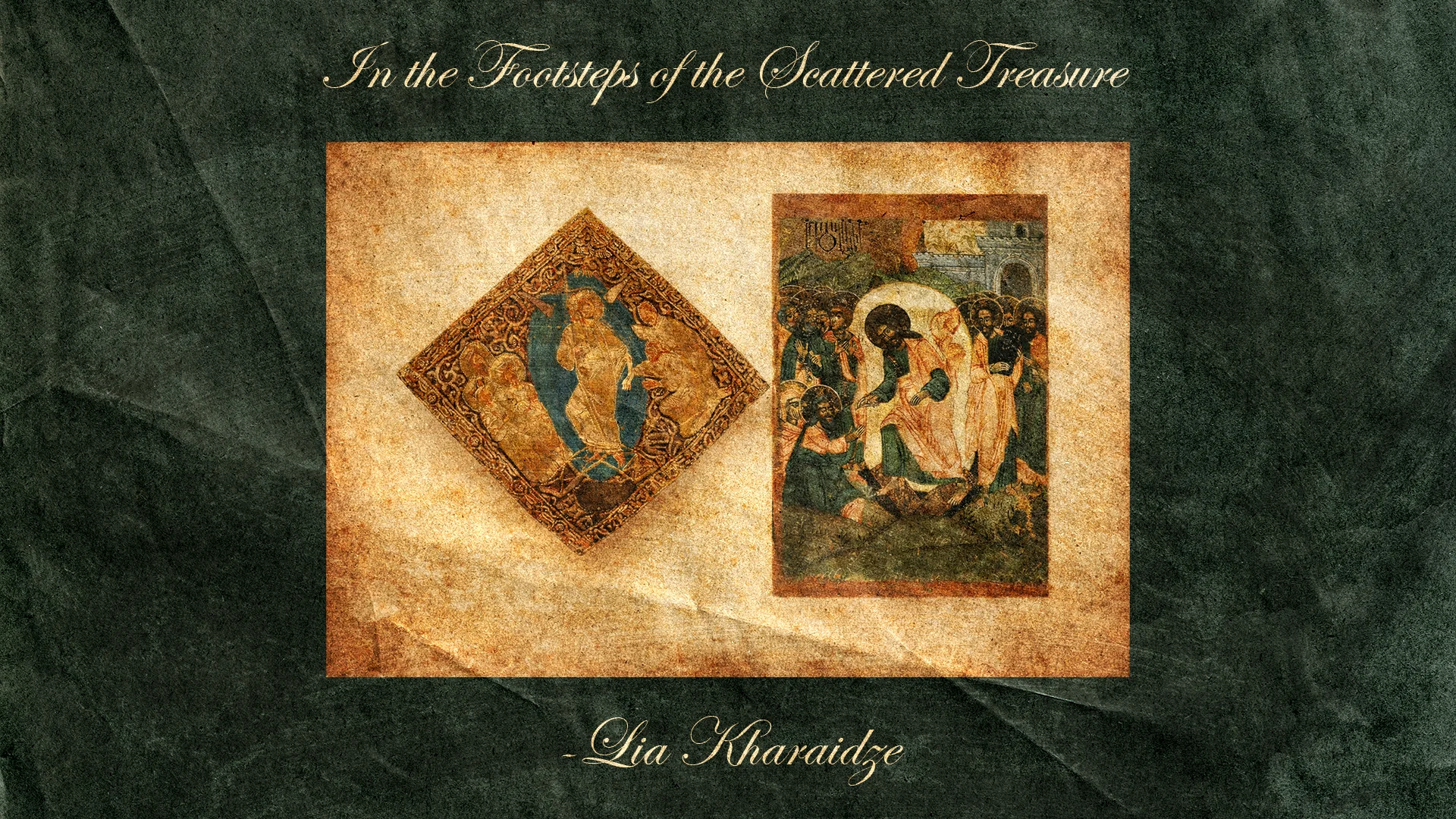
The unique art piece preserved from the “Katskhi Treasure” is the icon of the Savior of Katskhi, which is kept in the Mirianashvili Art Museum. The icon is decorated with three large sapphires. Both enamel and chasing techniques were used. It is made of gilded silver. The rare green enamel used on the icon is especially noteworthy – only about ten examples of this type survive in the world. The inscription on the icon mentions Eristavt-Eristavi Rati. This is the same Rati Eristavi who, together with the Bishop of Gainati, crowned Queen Tamar.
Alongside the manuscript school at the Katskhi Monastery, the Argveti Saeristao also had a school of woodcarving. This is proven by the vine door of the Mgvimevi Monastery, which was carved on site by a local master. The Vine Door is preserved in the Art Museum. The door of Mgvimevi Monastery stands out for its artistic quality and the skill of its woodcarving. It is known that this door was one of the most important relics of the monastery. The carving has reached us in very damaged condition. “A variety of clear and simple ornaments were used on the door. A fairly large number of fragments of this monument have survived.”
Georgian Christian art created outstanding works over the centuries, which became scattered throughout Georgia. Along with the Cathedral of the Nativity of the Savior in Katskhi, the Mgvimevi Nunnery also possessed great treasures. The Mgvimevi Monastery was famous for its abundance of precious icons, which were kept in the church for centuries: three large icons of the Vespers composition (the Virgin Mary, Christ, and John), individual icons such as the Savior, the Crucifixion, a large cross, and more. Unfortunately, many valuable items were stolen, and many were damaged. However, “these icons are vivid examples of the ‘Golden Age’ of creativity.” (Rusudan Kenia, Monument’s Friend, 1969.)
In November 2015, an exhibition by the National Archive was organized within the project “Treasures in the Funds of the National Archive.” The project was extremely important, as information became available about many exhibits that the public had not known about. It “opened a window” for new research. The photo exhibition was no less important. Unfortunately, only photographs of some exhibits or fragments have survived.
The treasure seems to call to us from afar, acting as a bridge between us and our glorious ancestors – our heritage, a source of great pride and responsibility.