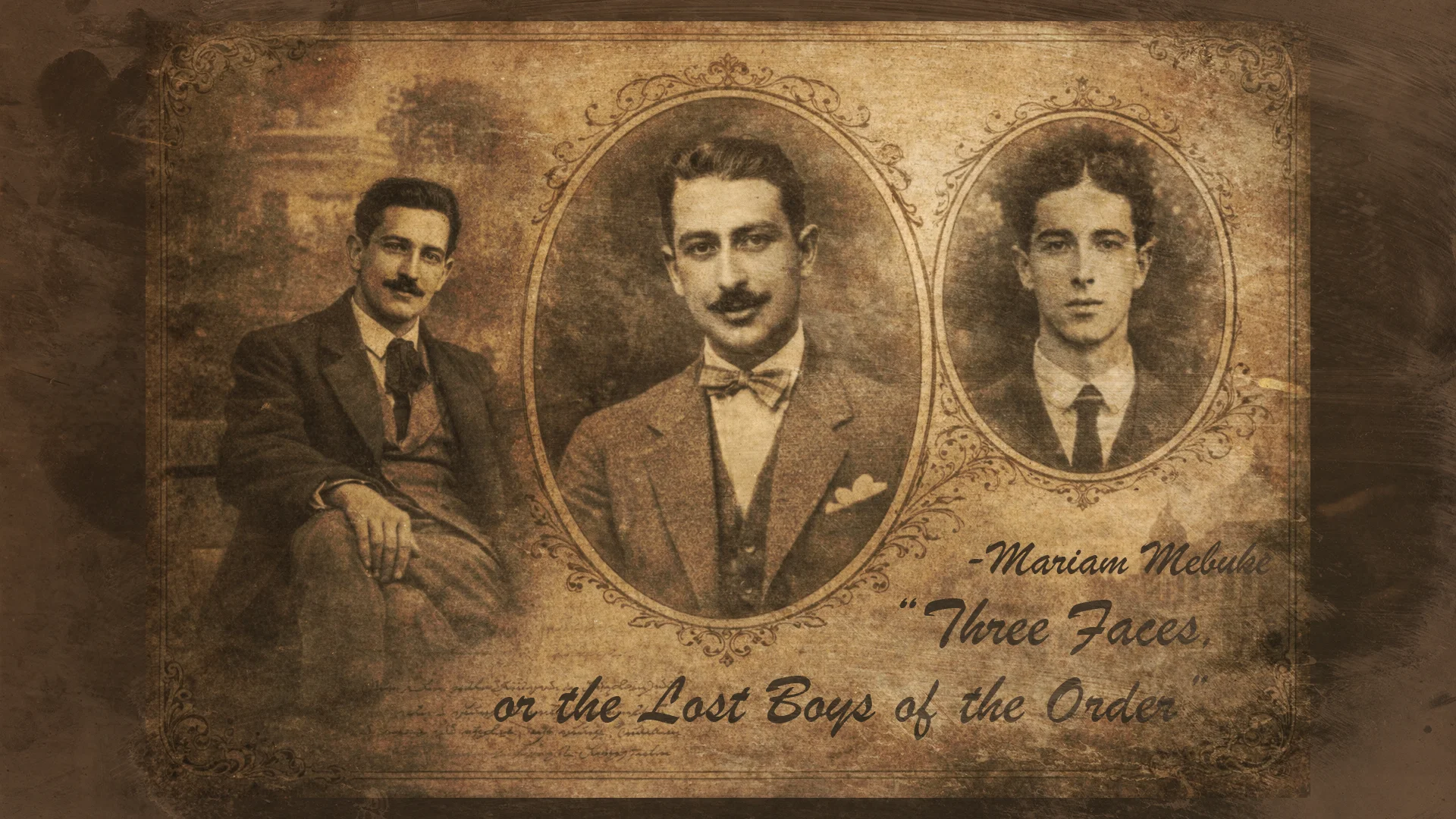
“When Culture Sleeps, This Is the Collapse of Poetry” (Zurab Rtveliashvili).
Author: Mariam Mebuke
Every year, a strange spring arrives in the city of white stones.
That is why we say that perhaps not one swallow, but the blooming magnolia at the “Red Bridge,” can definitely bring it. Kutaisi has never demanded more than the love of its inhabitants. Despite this, “falling in love at first sight” with the city was always special and emotional. It was easier for those who connected their creativity with this place. Probably, none of them looked for a muse elsewhere. Women went out to see the newly blossomed magnolia, including those who broke the rules of their era and walked the streets of Kutaisi with a cigarette in their hand. Our story should start from here…
The city. Chamomiles. Poetry and a few men (not angry). Now let’s add that mystical woman to this picture, and that’s all we need. It is not hard to imagine that this woman is Elene Bakradze, or, as Paolo called her, Ellie. We will speak less about the women of that time, the Third School, and the feminist movement. Now the dreamy wild goats, who did not submit to their fate, will be the main characters – those who, during the “cultural slumber” of the 20th century, could not imagine Kutaisi without poetry.
It turns out that a century can pass, many things can change, new buildings can grow like moss, the magnolia can bloom for the hundredth time, and still nothing can touch the soul of the city – it remains the same. In the city of white stones, everything is culture – living, tangible culture – whether you walk across the White Bridge or down any street where you can unexpectedly meet many familiar faces. Moreover, one person will definitely be called Paolo, another Titian, and if you see Shalva Karmeli (Gogiashvili) or meet Sandro Tsirekidze with Leli Japaridze, don’t be surprised. The monuments to Titian and Paolo show the respect and the unspoken affection for this order, and I, as a resident of this city, always greet them when I pass by. When talking about Edgar Poe – or rather, about poetry and Kutaisi together – we must remember the “Blue Horns.” It was in Kutaisi that European ideas began to spread, and culture was revived. Although all members of this poetic order were equally important in this process, I have decided to write about the relatively unknown, the lost boys. About those who did not know how to fight the tuberculosis bacillus and had only seconds to say goodbye to the world, leaving behind a few writings, sketches, or photographs – boys who became adopted sons of the city’s soul. Those who dedicated their works to others, while they themselves disappeared unnoticed. I must say that writing about them is not easy, but now we still have time to speak about the past as well as the future. Maybe these boys will also want to play again with the sun’s rays, and poetry will come alive in this city, friends will gather for spontaneous poetry evenings in the squares, and a new word will be discovered.
One of the boys of the Order of the BlueHorns is Alexander (Sandro) Tsirekidze. He was born in Kutaisi and, although he lived only twenty-nine years, he had a strong ambition to present the “name of the poet” in Georgia in a way that matched him and his generation, and to use the magazine he founded for this purpose. In his letter to Grigol Robakidze, Sandro Tsirekidze speaks directly about the real problems of literature, especially poetry, and mentions that because of a lack of material, the fourth issue of the magazine “Shvildosani” would probably not be published. This letter was written in 1920, when the newly formed Order faced more obstacles than supporters, which was not surprising considering the political regime of the time. Earlier, in his 1911 essay “Individualism,” the author raised the issue that the “Blue Horns” sharply opposed with their symbolism and views. In particular, he wrote about the fact that some people saw individualism as a primitive phenomenon. In the same letter, Sandro Tsirekidze notes: “A poet is a poet only when he is able to put his whole soul, his individuality, into his work and make us feel his personal emotions.” The truth is that with his work (although, in my opinion, this word describes a poet the least), he still proves that he was a man of feeling. It is also interesting that in his writings, you can find his native Kutaisi at every step.
“There is a temple in the middle of the bazaar. The old walls are heavy with sins.
The saints, thinned by frescoes, breathe moisture and incense.
The eyes of the mosaic Virgin Mary are virtuous. The mad deacon loves her.
During the service, he dreams of a staircase reaching up and covering her bare feet with a kiss.”
(The Mosaic Virgin Mary – excerpt, Sandro Tsirekidze)
Shalva Gogiashvili was also born in Kutaisi. He was the youngest member of the “Blue Horns,” and, as Kolau Nadiradze writes, “the youngest brother, Brother Benjamin.” He chose the pseudonym Carmel from the “Carmelite Order” and used it until he was twenty-four, until even Maro, who sold flowers on the street, could no longer help the patient suffering from tuberculosis. Somehow, it turned out that Shalva Gogiashvili’s poems also had their own fate, as the era prepared strange adventures for the works of all authors. He published only one collection in his lifetime. He planned to publish two more, but he died shortly afterwards. Later, another “Blue Horn,” Razhden Gvenetadze, apparently kept these collections, but in the end they disappeared – they were lost together with the poet. It is likely that this is one of his last poems:
“I curse the angel, I fear -he will not follow me.
I will perish – he will follow the sea with his wings spread wide.
But fate will not help escape the whirlwind.
I fight the bacilli of tuberculosis playing in the air.”
(The Chandelier with a Turquoise Lampshade Went Out – excerpt, Shalva Karmeli)
This is how “The First Visit of Death” (Kolau Nadiradze) happened, and then many more were lost to the mystical order of the “Blue Horns” (the word “mystical” is not accidental – Paolo speaks of the love of strange mysteries in his “Manifesto”). I will end my journey through the city of poets (or rather, poetry) with Levan (Leli) Japaridze. Another representative of the Kutaisi Classical Gymnasium, whose name, unfortunately, is no longer engraved on the two stone slabs in front of Akaki Tsereteli First Public School (although there is much more to say about the people whose names appear on those slabs). Leli translated actively and wanted to study at Oxford in the Faculty of Humanities, although some dreams remain only on paper. This is what happened to all the “Blue Horns,” although I hope that the names of the younger knights of this Order, together with Nikolo Mitsishvili, Razhden Gvenetadze, and others, will indeed be preserved by Kutaisi, as blue-blooded men should be, and most importantly, not angrily.
“The time has come for relief, and the blue sky has collapsed; the sun’s bed has been marked with red stripes.”
(‘Pregnant Sun’ – excerpt, Leli Japaridze, published in the second issue of “Tsisperi Kantsbi”)